Have you ever looked up a recipe on Google only to see ratings, cooking time, and calorie information shown in your search results? Have you ever looked up a product and seen its pricing and availability right away without clicking any link? This was possible because of schema markup.
What exactly is it, how does it work, and why should every website owner and SEO specialist be interested in implementing it correctly? Schema markup is one of the most powerful but underused instruments in technical SEO, helping search engines understand your content more accurately and improve your visibility in search results.
Although website owners usually focus on keywords, content, backlinks, and on-page SEO, schema markup works differently by helping search engines better understand the meaning and context of your content.
In this comprehensive guide to what schema markup is, we are going to talk about everything related to this topic, from giving you the most clear definition of what schema markup is and why it is important for SEO optimization to how schema markup works, types of schema markup, formats that you can use when creating markup, and how to test and validate your markup. If you’re completely new to SEO, it helps to first understand what SEO is before learning how structured data supports search visibility.
What Is Schema Markup? A Simple and Clear Definition

Schema markup is one of the types of structured data – the specific code you put on your website in HTML format for the better understand the meaning of the content by search engines. It is basically a special language through which website owners and search engines communicate more efficiently with each other.
To realize the reason why the schema markup was created and why it is important to implement it on your website, it is necessary to learn something about the way search engines work. For instance, when Google crawls your website, it reads all the text from it and tries to understand its meaning using advanced algorithms.
However, texts themselves may be ambiguous. Imagine the page containing such a text as “Apple – $999”. Does this text relate to the Apple computer, to the apple fruit for sale, or to the album produced by Apple?
Schema Markup Versus Structured Data – these two phrases often mean the same thing, but the subtle difference should be understood nevertheless. Structured data is the generic phrase for the data structured in a machine-readable form, while schema markup refers to structured data marked using the vocabulary described at schema.org.
The organization known as Schema markup is one implementation of structured data, which enables search engines to interpret webpage information in a standardized way.
Schema.org offers an enormous library of more than 800 types of structured data, ranging from products and recipes to events, people, organizations, and much more, each having a set of unique properties describing the type in question.
Why Is Schema Markup Important for SEO?

The role of schema markup in SEO is a multi-level one — ranging from the effect of the markup on how your pages will look in search results to the impact that it indirectly makes on rankings, CTRs, and visibility.
While schema markup itself isn’t a direct ranking factor, it supports many of the same objectives achieved through professional SEO services, including improved visibility, higher click-through rates, and better user experience.
Those details could include stars and ratings and review numbers, prices and availability of products, FAQs and other information shown directly in the listings, cooking times and nutritional value of recipes, events’ dates and locations — and many more.
This impact is proven and substantial. All studies show that rich results produce significantly higher click-through rates than similar standard results of a search. You will get higher CTR when your search result contains star ratings, price tags, or an FAQ section in addition to standard blue links of your competitors.
CTR enhancements are reported to be anywhere between 20% and 100% for rich results in comparison to non-rich ones, depending on the particular kind of schema markup and context of competition.
Understanding how Google interprets entities and relationships is also an important part of performing a comprehensive SEO competitor analysis, especially when evaluating how competitors earn rich results.
How Does Schema Markup Work?

Knowledge of how schema markup really works will provide you not only with an understanding of why it is important but also with the knowledge of how to do it.
First, let us discuss what schema markup means in technical terms.
Schema markup allows you to introduce machine-readable tags to your website content. These tags use standardized Schema.org vocabulary to identify and explain specific entities, properties, and relationships in your content. In such a way, while search engines are crawling through your website, they see not only your actual content but also the information about it provided in the form of schema markup.
And here is how the whole process looks in reality. Suppose there is a web page dedicated to a local restaurant. The visible content would consist of the restaurant’s name, address, phone number, working schedule, menu, and customer testimonials.
Human beings could easily interpret the meaning of all of these elements. However, an algorithm running on a search engine while processing millions of web pages at once could benefit greatly from being able to distinguish each of the mentioned pieces of data by their names, i.e., “This text is the name of the restaurant,” “This is the address of the restaurant,” etc.
Types of Schema Markup
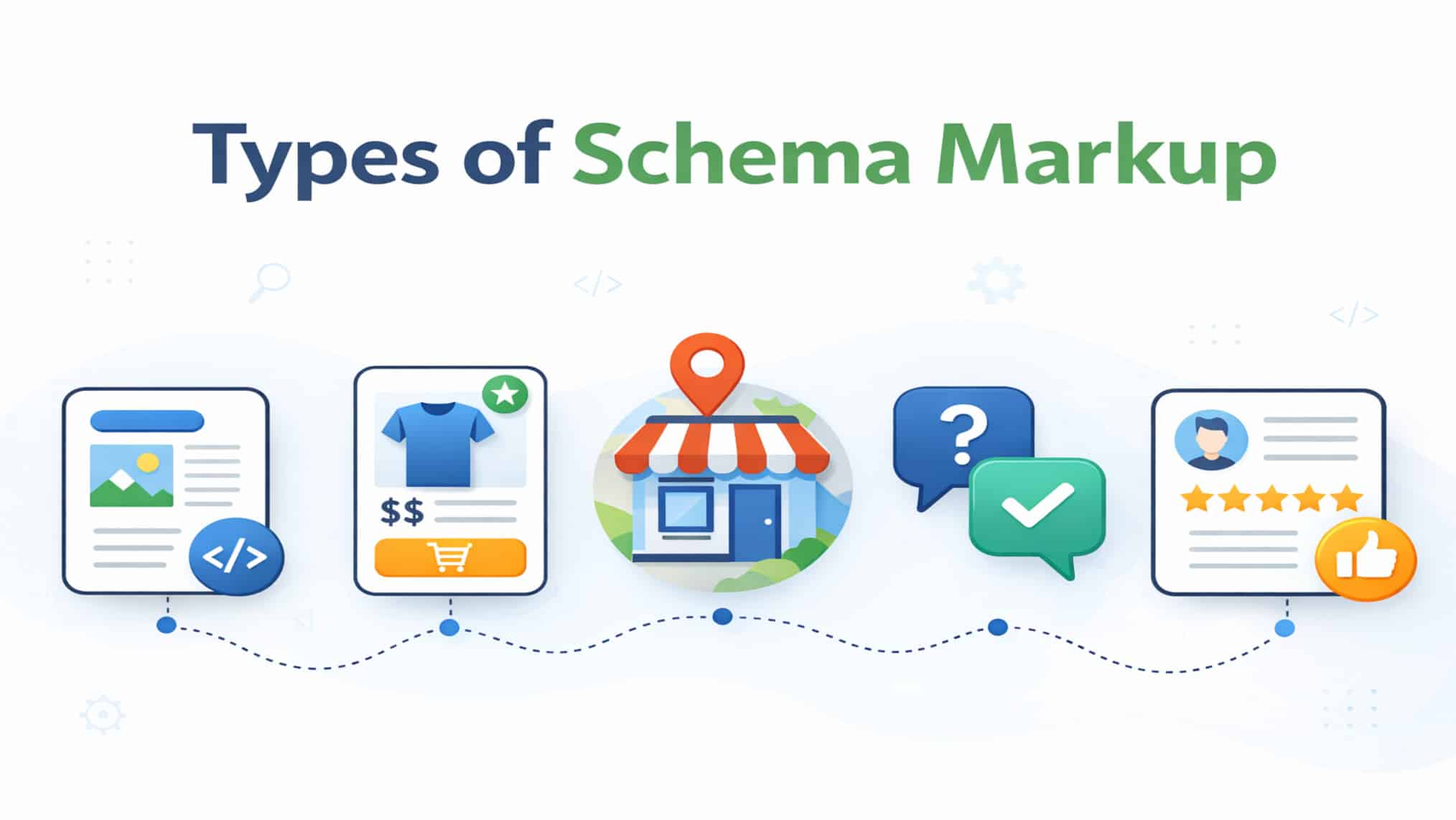
According to Schema.org, there are more than 800 types of schemas that cover almost every possible type of information. This is a complete list of the most popular and useful types of schemas and what their function is in terms of SEO.
Article Schema
Article Schema is among the most versatile schemas and can be applied to almost any webpage containing written content such as news articles, blogs, and editorials. It informs search engines that there is an article on the webpage along with structured data about the article.
The essential elements of the Article Schema are the title of the article, name and qualifications of the author, publication date, date last modified, featured image, publishing information, and a summary of the article. Proper implementation of the Article Schema assists Google in comprehending written content better so that it becomes more visible in Google News, Google Discover, and Top Stories carousels.
Product Schema
Product schema is probably the most important type of schema that e-commerce websites should implement — as it allows presenting product information within Google search and Google Shopping results. Product schema becomes even more effective when combined with optimized product pages, descriptive metadata, and strong eCommerce web design practices.
Using product schema, you can give search engines more structured data on your products that include:
- Name, description, and brand of the product
- Price of the product along with its currency, along with the availability status (In Stock/Out of Stock/Pre-order)
- Rating and reviews — which helps display star ratings in search engine result pages
- Product images in various formats and sizes
- Product identifiers like SKU, GTIN, MPN, and others
- Shipping details and return policy
- Offers like sales with valid dates and sellers
FAQ Schema
FAQ schema is one of the most instantly useful schema types for boosting the visibility and CTRs of your pages — and one of the most popular schema types since Google started to support FAQ rich results is used to mark up the page with a list of questions and their answers.
Once recognized and implemented by Google, this schema can turn your regular search result into an interactive FAQ section, where users will be able to open questions and view the answers directly from the search results page, without clicking on your website. This makes the presence of your listing larger and more prominent in the search results, making its space two to three times bigger than that of a standard listing.
FAQ schema has many SEO advantages. The larger listing means more exposure and attraction. The appearance of the actual questions and answers allows the user to see at once whether the page provides an answer to his/her particular question – thus increasing the relevance of the traffic besides its volume. Additionally, using FAQ schema, you have an opportunity to position your brand as an authority even before the user visits your site.
Review and Rating Schema
Review and Rating schema allows showing star ratings and reviews right within the search results of Google, making it one of the most visually attractive rich snippets. The gold stars next to the listing in Google search results are one of the most effective visual indicators on the whole page that attract attention and increase click-through rate.
Review schema could be used in two different forms. Aggregating Rating schema allows showing an aggregated rating, meaning an average rating based on several customers’ reviews. The review schema is applied to individual reviews with such properties as the name of the reviewer, the rating itself, the text of the review, and the date of the review.
It is crucial to learn Google review schema requirements because the use of the review schema to display the reviews of your website where you yourself become the reviewed person is prohibited. This means that review and rating schema must be used only for third-party review websites, pages with customer reviews for products, and editorial reviews of some services or businesses.
Local Business Schema
Local Business schema is one of the most useful schema types available for any business with a physical presence since it provides search engines with detailed and authoritative information about your business, which gets indexed by Google My Business Listings, Google Maps, and local search results.
The Local Business schema lets you include exactly labeled details about your business such as:
- Name, address, and phone number (NAP)
- Opening times daily, including holiday hours
- Geographic coordinates for accurate location
- Category and type of the business according to the hierarchy of business types at Schema.org
- URL of the website along with social networking pages
- Price range and accepted payment modes
- Customer review rating
Event Schema
The event schema is meant for use on pages which are promoting certain events – concerts, conferences, webinars, sporting events, theatre events, festivals and all sorts of happenings. If done right, the event schema will enable your events to be listed in Google Event rich results – special event listing in the search results, which show event listing with the date, time, place, ticket information.
The basic elements of the event schema include the name of the event, description of the event, date and time of its occurrence, the location (real or online address of the event), information about organizers, ticket availability and pricing, and event status (upcoming, cancelled, postponed, or virtual).
If it is an online event, the eventAttendanceMode element can help specify the attendance mode – in person, virtual, or both. Event rich results appear in Google searches if a user searches for events in a particular region or event type.
Recipe Schema
Recipe Schema is perhaps one of the richest and most visually appealing types of schema – providing for the inclusion of a vast range of recipe information structured data in Google search results, Google Images and the Google Assistant. For food bloggers, recipe sites, or anyone else that uses recipes in their content, Recipe Schema is certainly one of the most important schema implementations to consider.
Among the vast range of properties supported by Recipe Schema are:
- Recipe name, description, and author
- Recipe preparation time, cooking time, and total time
- Number of people served
- Number of calories and nutrition information
- Ingredients and quantities used
- Recipe instructions
- Recipe category (appetizer, entrée, dessert, etc.)
- Type of cuisine (Italian, Mexican, Indian, etc.)
- Diet types (Vegan, gluten-free, diabetic, etc.)
- User review aggregate rating
- Images/Videos of recipe
Person and Organization Schema
Person schema and Organization schema are fundamental schema types that assist in the identification of the main entities relating to your website, namely, your business as an organization and the main people who are related to your business (the founders, the authors, the experts).
Organizational schema assists search engines in having authoritative data about your business or organization, such as its legal name, logo, founding date, description, contact details, social media accounts, and the link to the organization’s website. The use of Organizational schema on your website is crucial for Google to be able to identify your business entity and link it to the Knowledge Graph.
Schema for a person is useful to individual professionals, content writers, celebrities, and authors since it provides structured data about a certain person and includes the individual’s name, profession, organization, biography, social media handles, and topics of expertise.
In websites with content written by individual writers, the Person Schema will help in establishing author authority, especially now that Google is placing more importance on E-E-A-T (Experience, Expertise, Authoritativeness, and Trustworthiness) signals of content creators.
Breadcrumb Schema
The breadcrumb schema markup includes the navigation breadcrumbs that show the path of the user in the website hierarchy, like “Home > Electronics > Laptops > MacBook Pro.” If used correctly, the breadcrumb schema makes Google display the navigation breadcrumbs in the search results instead of the usual URL — giving users an instant clue on the position of the page in the website hierarchy and making the search result more helpful and click-worthy. Clean website architecture and breadcrumb navigation also contribute to better crawling and overall website optimization.
Video Schema
Video Schema markup using the VideoObject schema will help mark up your video content on your website with structured data to aid search engines in indexing your videos in a better way and making your videos eligible for Google’s Video Rich Results and the Video tab in search results.
Some important properties that need to be marked up under the Video schema are the title of the video, description of the video, thumbnail URL of the video, upload date of the video, video duration, and URL of the actual video content. If there are defined chapters in your video content, then using the hasPart and Clip properties, you can mark up certain timestamps of the video.
The schema for video content is especially useful for websites where the video is uploaded directly and not embedded from YouTube, since YouTube indexes its own videos automatically, whereas videos without schema markup on other sites may not be indexed by Google’s video indexing. For anyone who creates content or uses videos to demonstrate their products, Video schema should be implemented to ensure maximum organic reach of their video content.
How to Test and Validate Your Schema Markup

However, the successful implementation of the schema markup is just half of the job; another crucial task is to ensure that it has been implemented correctly and can be parsed by the search engines.
The Rich Results Test by Google is one of the primary tools for validating the schema markup that should display the rich results in Google. This tool can be accessed via search.google.com/test/rich-results and lets you test either a URL or an HTML snippet to see.
Besides validating structured data, website owners should regularly monitor technical issues such as crawl errors, broken links, and 301 redirects to maintain strong SEO performance.
Some of the common errors that occur due to schema markup are:
- Missing properties — each schema requires some properties, which are considered mandatory by Google, for its rich results to appear. In the case of Product schema, name, image, and either one of the following is required: description, reviews, or rating.
- Invalid property value — all properties should be entered in their proper form. Properties related to date require the use of ISO 8601 format (YYYY-MM-DD). Price-related properties should only consist of numeric values and not any currency symbol.
- Many of these issues can be discovered using professional SEO tools before they negatively impact your website’s visibility.
- Incorrect schema type nesting – Certain types of schema must be nested within other schema types in a particular way. For instance, Offer type schema markup must be nested within a Product type schema.
- JSON-LD syntax errors – Missing commas, unclosed brackets, etc., are examples of JSON syntax errors that can make the whole JSON-LD markup block fail.